
 简体中文 (中国)
  English
  Español
  Русский
  Turkish
  Persian (فارسی)
  Arabic (العربية)
SEC Whistleblower Program: Reporting Securities Fraud and Market Manipulation
The U.S. Securities and Exchange Commission, commonly known as the SEC, operates a whistleblower program that allows individuals to report possible violations of federal securities laws. The program is especially important in cases involving securities fraud, insider trading, false investor disclosures, accounting misconduct, unregistered securities offerings, Ponzi schemes, and market manipulation.
For individuals with credible information about securities-related misconduct, the SEC Whistleblower Program may provide a confidential path to report wrongdoing. In certain cases, an eligible whistleblower may also receive a financial award if the information leads to a successful enforcement action.
Because SEC whistleblower submissions can involve complex legal, employment, confidentiality, and evidentiary issues, potential whistleblowers should consider obtaining legal advice before submitting information to the government.
What Is the SEC Whistleblower Program?
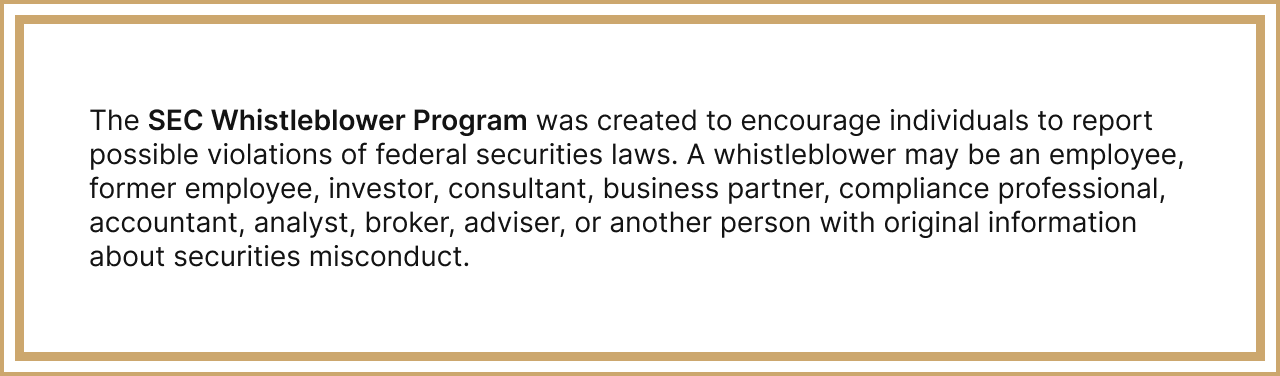
The program is not limited to insiders. A person does not necessarily have to work for the company involved. What matters is whether the individual has credible, specific, and useful information that may assist the SEC in identifying, investigating, or proving a securities law violation.
The SEC may award eligible whistleblowers between 10% and 30% of the money collected in a successful enforcement action where monetary sanctions exceed $1 million. However, receiving an award is not automatic. The whistleblower must satisfy specific legal and procedural requirements, including proper submission of information through the SEC’s whistleblower process.
Common Types of Securities Fraud Reported to the SEC
Whistleblower tips may involve many different forms of securities misconduct. Common examples include:
Market Manipulation
Market manipulation occurs when individuals or entities attempt to artificially affect the price, trading volume, or market perception of a security. This may include coordinated trading, false promotional campaigns, misleading public statements, manipulative social media activity, or schemes designed to create artificial demand.
Market manipulation can harm ordinary investors by creating a false impression of market interest, liquidity, or value.
Pump-and-Dump Schemes
A pump-and-dump scheme usually involves artificially promoting a stock or security through false or misleading statements. After the price rises, the promoters sell their holdings at the inflated price. Once the promotion ends or the truth becomes known, the price often collapses, leaving investors with significant losses.
These schemes may involve penny stocks, microcap companies, foreign issuers, crypto-related securities, online investment groups, social media promotions, paid newsletters, or false press releases.
Insider Trading
Insider trading may occur when a person trades securities while in possession of material, nonpublic information. It may also involve tipping others who then trade based on that confidential information.
Examples may include trading before a merger announcement, earnings release, regulatory approval, major lawsuit, financing transaction, or other significant corporate event.
Accounting and Financial Statement Fraud
Accounting fraud may involve false revenue recognition, concealed liabilities, improper valuation of assets, misleading financial statements, or manipulation of company books and records. These cases often involve public companies, auditors, executives, finance departments, or internal reporting failures.
False or Misleading Investor Disclosures
Companies and individuals may violate securities laws by making materially false or misleading statements to investors. This may include misrepresentations in SEC filings, offering documents, investor presentations, press releases, earnings calls, private placement memoranda, or marketing materials.
Ponzi Schemes and Investment Fraud
A Ponzi scheme generally involves using money from new investors to pay earlier investors, rather than generating legitimate profits. These schemes often rely on false promises of high returns, low risk, guaranteed profits, or exclusive investment opportunities.
Unregistered Securities Offerings
Some whistleblower cases involve companies or individuals selling securities without proper registration or exemption. This may include private offerings, crypto tokens, promissory notes, investment contracts, or other financial products marketed to investors.
Crypto and Digital Asset Misconduct
The SEC may also investigate certain crypto-related schemes where the digital asset, token, staking product, lending program, or investment opportunity qualifies as a security under U.S. law. Whistleblower tips may involve fraud, false disclosures, misuse of investor funds, market manipulation, or unregistered offerings.
What Makes a Strong SEC Whistleblower Submission?
A strong SEC whistleblower submission should be organized, factual, and evidence-based. The SEC receives many tips, and vague allegations are less likely to receive meaningful attention. A persuasive submission should clearly explain what happened, who was involved, why the conduct may violate securities laws, and what evidence supports the allegations.
A whistleblower submission should generally include:
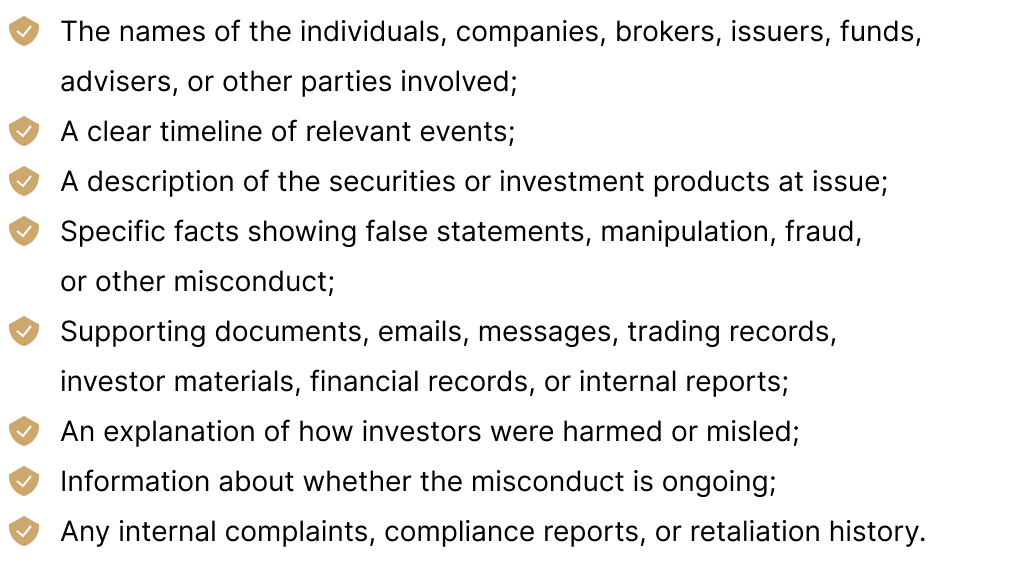
The goal is to provide the SEC with information that is specific, credible, and useful. A whistleblower should avoid speculation and focus on facts that can be verified.
Can a Whistleblower Report Anonymously?

This attorney acts as the intermediary between the whistleblower and the SEC. The attorney may submit the Form TCR on behalf of the whistleblower and help preserve confidentiality during the process.
Anonymous reporting may be especially important where the whistleblower is still employed by the company, fears retaliation, is concerned about professional consequences, or possesses sensitive information.
Whistleblower Awards: 10% to 30%
Eligible whistleblowers may receive between 10% and 30% of the money collected in successful SEC enforcement actions where monetary sanctions exceed $1 million. In some cases, awards may also be connected to related actions brought by other regulatory or law enforcement authorities.
However, award eligibility depends on compliance with SEC rules. A whistleblower must generally provide original information voluntarily, submit it in the required manner, and satisfy the procedural requirements for claiming an award.
The SEC considers multiple factors when determining the amount of an award, including the significance of the information, the level of assistance provided, the SEC’s law enforcement interest, and whether the whistleblower participated in internal compliance systems.
Whistleblower Retaliation
Whistleblowers may face retaliation from employers or business partners. Retaliation may include termination, demotion, suspension, threats, harassment, loss of compensation, blacklisting, or other adverse treatment.
A person considering a whistleblower submission should be careful before taking documents, forwarding company emails, recording conversations, accessing systems, or disclosing confidential information. Even where the underlying report is legitimate, mishandling privileged, confidential, or unlawfully obtained materials can create legal risk.
An attorney can help evaluate the safest way to preserve and present evidence while reducing unnecessary exposure.
Internal Reporting vs. SEC Reporting
Some whistleblowers first report misconduct internally through a compliance department, legal department, audit committee, supervisor, or corporate hotline. Others go directly to the SEC.
The best approach depends on the facts. Internal reporting may help a company correct misconduct, preserve evidence, or demonstrate that the whistleblower acted responsibly. However, internal reporting may also create risks if the company ignores the complaint, destroys evidence, retaliates, or attempts to identify and silence the whistleblower.
Before deciding whether to report internally, externally, or both, a whistleblower should carefully evaluate the nature of the misconduct, the reliability of internal compliance channels, the urgency of the issue, and the risk of retaliation.
International Whistleblowers
A whistleblower does not necessarily need to be a U.S. citizen or reside in the United States to submit information to the SEC. Many securities fraud and market manipulation cases involve foreign companies, offshore accounts, cross-border securities offerings, foreign issuers listed in U.S. markets, or misconduct affecting U.S. investors.
International whistleblower matters may involve additional legal issues, including foreign privacy laws, employment agreements, data protection rules, bank secrecy laws, sanctions issues, and cross-border evidence collection.
For this reason, international whistleblowers should obtain legal advice before submitting documents or communicating with regulators.
Why Legal Counsel Matters
An attorney can play an important role in SEC whistleblower matters. Legal counsel can help evaluate whether the information may qualify for the SEC Whistleblower Program, prepare a clear and persuasive submission, organize evidence, protect confidentiality, and preserve award eligibility.
Counsel may also assist with:
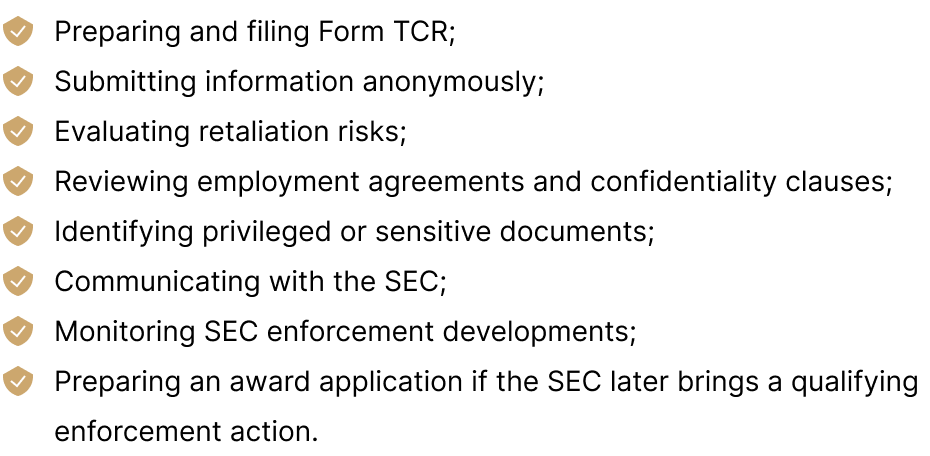
Legal representation is particularly important where the whistleblower is still employed by the company, has access to confidential documents, is located outside the United States, was involved in compliance or legal functions, or may have personal exposure related to the underlying conduct.
Conclusion
The SEC Whistleblower Program is a powerful mechanism for reporting securities fraud, market manipulation, insider trading, accounting misconduct, Ponzi schemes, and other violations of federal securities laws. In appropriate cases, whistleblowers may help protect investors and financial markets while also becoming eligible for a financial award.
However, whistleblower submissions require careful preparation. The way information is collected, organized, and submitted can affect confidentiality, legal risk, and award eligibility. Anyone considering an SEC whistleblower submission should seek legal guidance before taking action.