
 English
  Español
  Русский
  Turkish
  Persian (فارسی)
  Arabic (العربية)
  简体中文 (中国)
INTERPOL Request Declined: How to Appeal, File a CCF Revision, and Challenge a Red Notice
An INTERPOL Red Notice, Diffusion, or other entry in INTERPOL’s systems can create serious legal and practical consequences. A person may face detention during travel, secondary inspection at borders, immigration complications, banking issues, reputational harm, and difficulty conducting international business.
For this reason, individuals who believe they are the subject of abusive, politically motivated, inaccurate, or unlawful INTERPOL data often submit a request to the Commission for the Control of INTERPOL’s Files, commonly known as the CCF. The CCF may be asked to provide access to personal data, correct inaccurate data, delete non-compliant data, or revise a previous decision.
But what happens if the CCF declines the request?
A declined request is not necessarily the end of the matter. However, the next step is not a normal “appeal” in the court sense. In most cases, the available remedy is an application for revision, which is subject to strict requirements and must be supported by newly discovered, relevant facts.
The Role of the CCF

The CCF does not decide whether a person is guilty or innocent. It does not retry the underlying criminal case. It does not usually determine whether a national prosecution is valid under domestic law. Its role is narrower:

This distinction is important. Many unsuccessful INTERPOL applications fail because the submission focuses only on innocence or unfairness, without connecting the facts to INTERPOL-specific rules. A strong submission should explain why the data is incompatible with INTERPOL’s rules, not merely why the applicant disagrees with the requesting country’s criminal allegations.
What Does It Mean When the CCF Declines a Request?
If the CCF declines a request for deletion, correction, or revision, it usually means that, based on the evidence available at the time, the CCF was not persuaded that the data violated INTERPOL’s rules.
That does not necessarily mean that the criminal case is fair, lawful, or justified. It means that the applicant did not meet the CCF standard for removing, correcting, or restricting the data.
A request may be declined for several reasons:
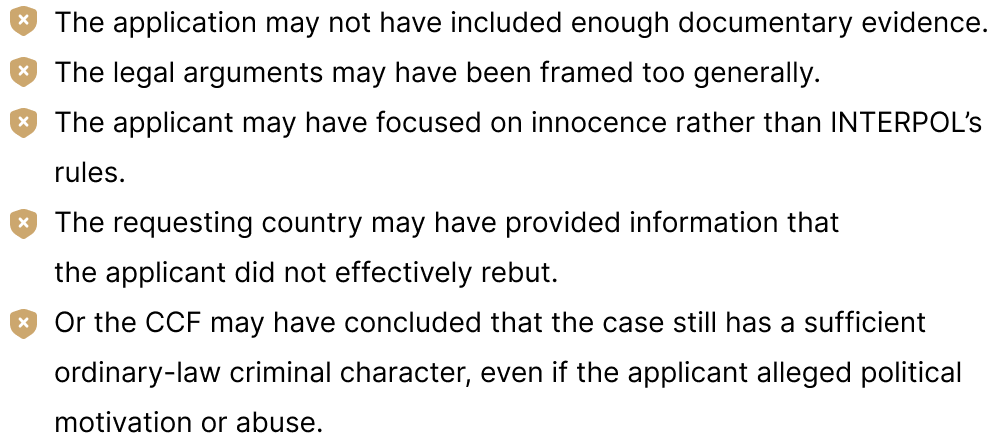
Is There a Right to Appeal a CCF Decision?
There is no ordinary appeal process comparable to an appeal from a court judgment. However, an applicant may submit an application for revision of a CCF decision.
A revision request is not simply a second chance to repeat the same arguments. It must be based on newly discovered and relevant facts that could have led the CCF to reach a different conclusion if those facts had been known when the original request was considered.
This is a narrow remedy. The applicant must show more than disagreement with the CCF’s reasoning. The applicant must identify a new fact or development, explain when it was discovered, and demonstrate why it could have changed the original decision.
What Counts as a New Fact?
A new fact may include a development that occurred after the original CCF decision or a fact that existed earlier but was discovered only later. The key question is whether the fact is relevant, material, and capable of affecting the CCF’s prior analysis.
Examples of potentially relevant new facts may include:
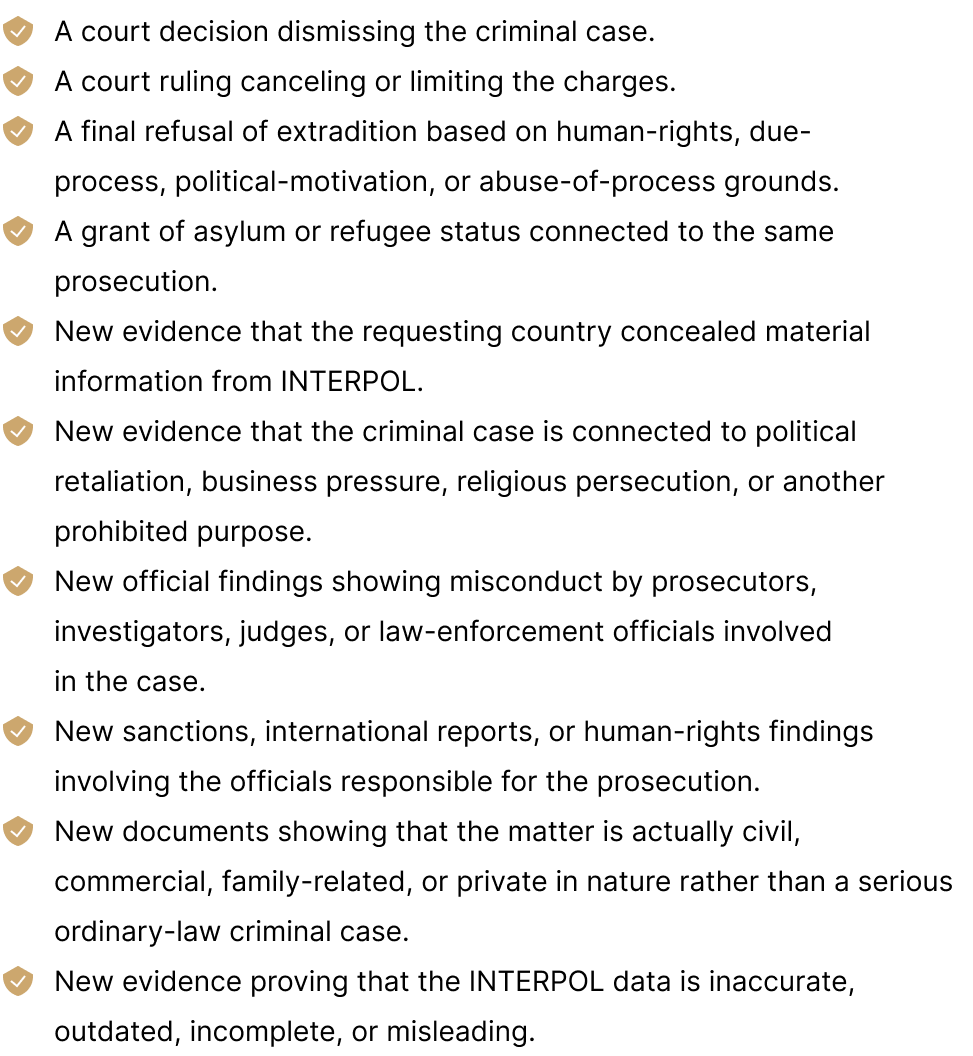
Not every new document will be enough. The applicant must explain why the new fact matters under INTERPOL’s rules and how it could have changed the CCF’s original conclusion.
Timing: The Six-Month Rule
An application for revision should generally be submitted within six months after discovery of the new fact. This deadline is critical.
The applicant should clearly document the date when the new fact was discovered. For example, if the new fact is a court judgment, the filing should identify the date of the judgment and the date the applicant received it. If the new fact is a sanctions designation, official report, or government decision, the filing should identify the publication date and explain why that development is relevant to the INTERPOL matter.
A revision request filed outside the six-month period may be rejected unless there is a strong explanation for the delay.
How to Prepare a Strong Revision Request
A strong revision request should be organized, evidence-based, and legally focused. It should usually include:
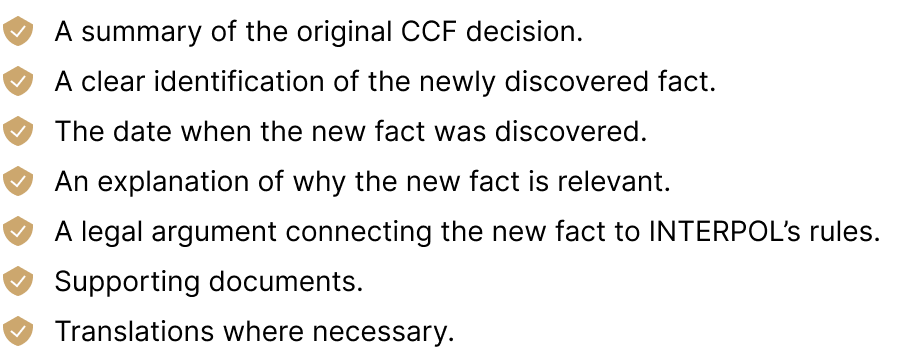
A request that the CCF revise its prior decision and delete, correct, or restrict the challenged data.
The submission should avoid emotional accusations, excessive repetition, or unsupported conclusions. The CCF generally reviews written submissions and documents, so clarity and evidence are essential.
Common Mistakes After a Declined INTERPOL Request
One common mistake is resubmitting the same application without new evidence. This usually does not satisfy the revision standard.
Another mistake is focusing only on innocence. Innocence may be relevant, but the CCF’s central question is whether the data complies with INTERPOL’s rules.
A third mistake is failing to address the requesting country’s version of the case. A strong submission should anticipate how the requesting country may defend the prosecution and explain why that position is incomplete, misleading, or incompatible with INTERPOL standards.
A fourth mistake is submitting disorganized evidence. Documents should be clearly labeled, translated where necessary, and connected to specific legal arguments.
A fifth mistake is waiting too long. If a new fact exists, the revision strategy should be evaluated immediately because of the six-month deadline.
Can INTERPOL Be Sued?
Suing INTERPOL directly is generally very difficult. INTERPOL is an international organization with its own legal personality, separate from its member countries, and it benefits from privileges and immunities intended to protect its official functions.
In practice, this means that national courts may be reluctant, or legally unable, to hear claims against INTERPOL for actions connected to its official activities, including the processing of Notices, Diffusions, or law-enforcement data. Therefore, in most cases, the more practical remedy is not a lawsuit against INTERPOL itself, but a properly prepared request to the CCF for access, correction, deletion, or revision of INTERPOL data.
Depending on the facts, a person may also consider legal remedies against the requesting country, challenge arrest or extradition proceedings in the country where they are located, or raise the INTERPOL issue in immigration, asylum, sanctions, or human-rights proceedings. The correct strategy depends on the country involved, the nature of the prosecution, the existence of a Red Notice or Diffusion, and the available evidence of abuse, political motivation, or due-process violations.
What If INTERPOL Declines a Country’s Request for a Notice or Diffusion?
There is another important situation: INTERPOL may decline a request by a member country to publish a Red Notice or process a Diffusion because the request does not comply with INTERPOL’s rules.
If INTERPOL refuses or cancels a Notice or Diffusion, that can be very significant for the individual. It may show that INTERPOL channels should not be used in connection with that case. This may be useful in immigration proceedings, extradition defense, asylum matters, banking compliance, or other legal contexts.
However, a favorable INTERPOL outcome does not automatically dismiss the national criminal case. The requesting country may still maintain a domestic arrest warrant, continue its prosecution, or attempt to seek extradition through diplomatic or treaty channels. Therefore, a favorable INTERPOL decision is important, but it should not be treated as a complete resolution of all legal risk.
Frequently Asked Questions
1. Can I appeal an INTERPOL decision if my request was declined?
There is usually no ordinary appeal in the same way there would be in a court case. However, a person may submit an application for revision if there are newly discovered, relevant facts that could have affected the CCF’s original decision. A revision request should not simply repeat the same arguments from the original application.
2. What is the difference between an appeal and a revision request?
An appeal usually asks a higher authority to review whether the first decision was wrong. A revision request asks the CCF to reconsider its own decision because new and relevant facts have been discovered. The key issue is whether the new information could have changed the original result.
3. What counts as a “new fact”?
A new fact may include a court decision, dismissal of charges, refusal of extradition, grant of asylum or refugee status, newly discovered evidence of political motivation, proof of procedural abuse, or official findings showing misconduct by the authorities involved in the case. The fact must be relevant and material, not merely repetitive or general.
4. Is claiming innocence enough to win an INTERPOL revision?
Usually, no. INTERPOL and the CCF do not function as a criminal trial court. The applicant should connect the facts to INTERPOL’s rules, such as political motivation, human-rights concerns, lack of due process, disproportionality, inaccurate data, or misuse of INTERPOL channels.
5. How much time do I have to file a revision request?
A revision request should generally be submitted within six months after discovery of the new fact. The applicant should clearly explain when the new fact was discovered and provide documents proving the timeline.
6. What happens if I submit the same arguments again?
If the new filing simply repeats the same arguments without new facts, the CCF may reject the request or decline to reconsider the matter. A successful revision request should explain what is new, why it is important, and how it could have affected the prior decision.
7. Can a declined CCF request make my situation worse?
A declined request does not automatically make the underlying criminal case worse. However, it may mean that INTERPOL data remains active, which can continue to create travel, immigration, banking, or law-enforcement risks. For that reason, any follow-up filing should be carefully prepared.
8. If INTERPOL deletes a Red Notice, does that end the criminal case?
No. Deletion of INTERPOL data does not automatically dismiss the national criminal case or cancel a domestic arrest warrant. It only means that INTERPOL channels should no longer be used to circulate or process that data, subject to the terms of the CCF decision.
9. Can a country still seek extradition after INTERPOL deletes or refuses a Notice?
Yes. A country may still attempt to pursue extradition through diplomatic or treaty channels, even if INTERPOL refuses or deletes a Notice. However, a favorable INTERPOL decision may be useful evidence in immigration, extradition, asylum, or other legal proceedings.
10. What documents should be included in a revision request?
The filing should include the prior CCF decision, a clear explanation of the new facts, evidence showing when the new facts were discovered, court decisions or official documents, translations where necessary, and a legal argument explaining why the new facts justify revision.
11. Can political motivation be a basis for deleting INTERPOL data?
Yes, if properly supported by evidence. INTERPOL’s Constitution prohibits intervention or activities of a political, military, religious, or racial character. However, the applicant must provide specific facts and documents showing that the case is politically motivated or otherwise incompatible with INTERPOL’s rules.
12. Should I travel while an INTERPOL matter is unresolved?
Travel may create risk if a Red Notice, Diffusion, or national warrant remains active. A person may face secondary inspection, detention, visa issues, or immigration complications. Before international travel, the individual should carefully assess the status of the INTERPOL matter and the legal risks in the destination and transit countries.
Conclusion
When an INTERPOL request is declined, the applicant should not assume that the matter is over. But the next step must be carefully evaluated. A revision request is not a routine appeal. It requires newly discovered, relevant facts that could have changed the original decision.
The strongest cases are built on documents, legal precision, and a clear connection between the new evidence and INTERPOL’s own rules. A properly prepared revision request can be an important tool for individuals facing politically motivated prosecutions, abusive international police cooperation, or inaccurate data in INTERPOL systems.
Anyone facing this situation should act quickly, preserve all new evidence, and seek advice from counsel experienced in INTERPOL, extradition, immigration, and cross-border criminal matters.